
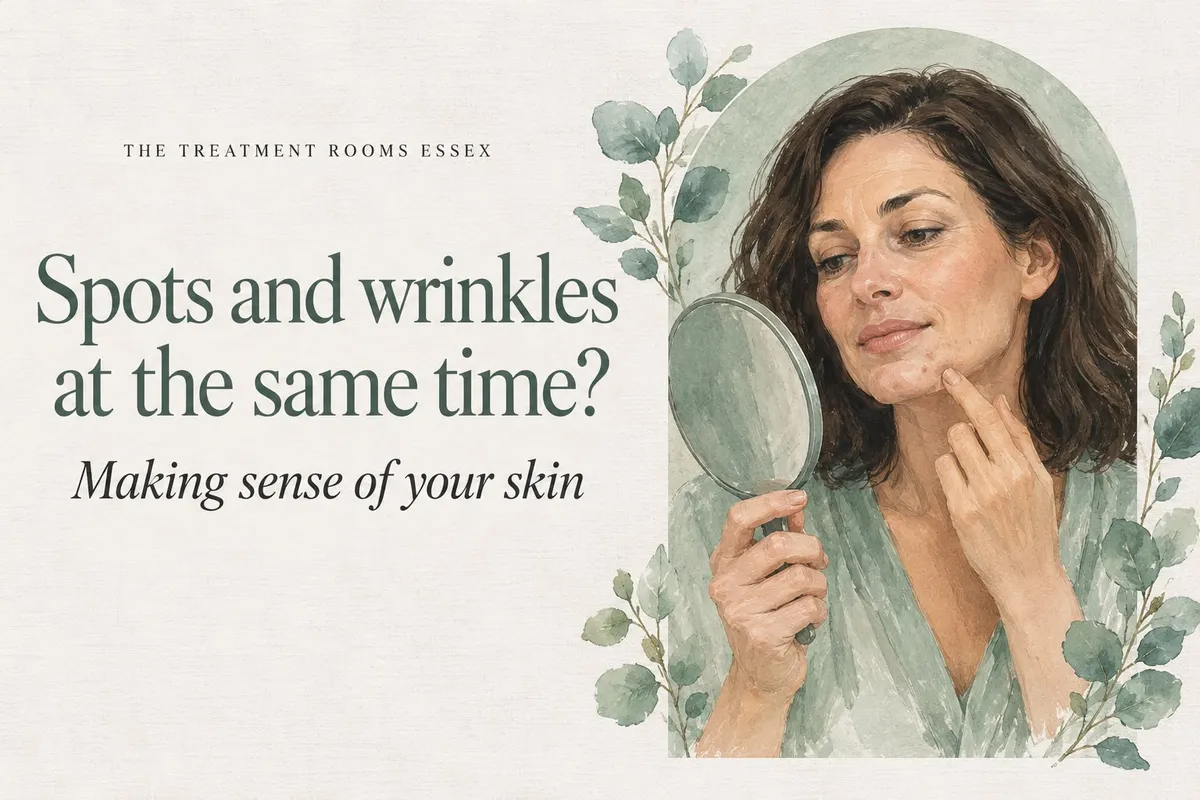
Spots and wrinkles at the same time and what your skin needs
You are looking for help with fine lines, then a sore spot arrives on your chin as though it has been invited. Meanwhile, your cheeks feel dry. The spot treatment makes them tighter, the rich cream feels wrong, and your bathroom shelf is beginning to resemble a very expensive guessing game.
If your search history includes “spots on chin at 40” and “dry skin and acne at the same time”, I can understand the frustration. You want clearer, more comfortable skin and some sensible advice. You should not have to choose which concern you are allowed to care about.
Adult breakouts deserve a fresh assessment
Acne can continue into adulthood or appear for the first time later in life. Hormonal fluctuations are one possible contributor, including around menopause. However, the location of a spot alone does not diagnose a hormonal problem, and not every facial bump is acne. [5]
That matters because the answer should follow the assessment. “My chin keeps breaking out” gives me a starting point. I will want to know how often it happens, whether the spots hurt, what else your skin is doing and what you have tried. Your skin has more to tell us than a single close-up photograph.
What you mean when you say nothing works
You might mean the spots return as soon as one settles. You might mean a product helped the breakouts but made your face sore. Or you might mean you cannot tell what helped because you changed three things in the same week. Those are different problems, and they need different conversations.
Tell me what success would look like in everyday life. Less discomfort? Less time covering your chin? A routine you can follow without checking ten conflicting videos? I want to understand that before discussing a treatment. Clearer advice can be useful long before you choose an appointment from the treatment menu.
Avoid treating your whole face like one spot
Dermatologists advise gentle care for acne-prone skin and caution against scrubbing or drying it out. Moisturiser can still have a place when you have breakouts. Products labelled non-comedogenic are designed not to clog pores, although individual tolerance still matters. [6, 7]
In practical terms, I would want to review your cleanser, moisturiser and any targeted products together. I would also ask how much you apply and how often. The name on the bottle is only part of the story. Two people using the same product can be following very different routines.
Please include the things you are slightly embarrassed to mention. The scrub you brought back out of the cupboard, the emergency spot gel and the product borrowed from your teenager all count. I am interested in understanding the routine, not marking your homework.
Fine lines do not make harsh skincare necessary
You are allowed to want support with skin texture while also wanting fewer spots. That does not mean every concern needs its own powerful active immediately. I would rather help you decide which issue matters most right now, then build the plan in an order your skin can manage.
Retinoids can be used for some acne and signs of skin ageing, but they can irritate and are not appropriate for everyone. Avoid them during pregnancy or when trying to conceive, and seek suitable professional advice. [23] A stronger formula is not automatically a better choice for your face. [8]
If you already use prescribed acne treatment, tell me. Do not stop it because you have booked a facial. Any skincare or treatment discussion needs to take your existing medical care into account, including advice from your prescriber about combining products or procedures.
Give the plan a fair chance
Changing products every few days makes results harder to judge. The American Academy of Dermatology recommends allowing an acne product around six to eight weeks to show improvement when used as directed. That does not mean continuing through significant irritation or waiting while acne becomes severe. [9]
At a consultation, I can help you decide what you are monitoring and when a review makes sense. We might discuss comfort, frequency of breakouts and how the routine fits your day. Progress should have a meaning you understand, rather than depend on whether one photograph happens to have kinder lighting.
What a consultation in Braintree can offer
At The Treatment Rooms, I begin with your concerns and the care you already use. We can review homecare and consider whether any of the clinic's skin services are appropriate. I will explain the reasoning behind a recommendation, including when I think medical assessment is the more useful next step.
You can tell me if you have spent money on things that disappointed you. You can also tell me if a long programme feels overwhelming. I want you to leave with a clearer idea of what happens next. You should not need to buy everything discussed in order to ask for help.
If a treatment is suitable, we will talk about preparation, possible reactions and aftercare. I will not promise that one facial will clear persistent acne or remove every line. Your plan needs to respect both the condition of your skin and the limits of what a cosmetic service can offer.
When to involve your GP
Painful deeper spots, scarring, worsening acne or breakouts affecting your wellbeing are reasons to seek medical advice. The NHS recommends GP assessment for moderate or severe acne, or when pharmacy treatment has not worked. You deserve support before it becomes something you dread facing each morning. [10]
Book a consultation
If you are tired of choosing between a sore chin and uncomfortable cheeks, let us review the whole picture. Bring your products, your questions and the things that have not worked. I will help you understand the options without adding another confusing shopping list.
Book a consultation at The Treatment Rooms in Braintree. Your skin, your goals, and a sensible place to start. There is room for all your questions here.
Sources
Sources for this article. Numbers match the references in the text.
5. American Academy of Dermatology. Adult acne
6. American Academy of Dermatology. Acne tips for managing
7. American Academy of Dermatology. Moisturizer and acne
8. American Academy of Dermatology. Retinoid or retinol
9. American Academy of Dermatology. Adult acne treatment
10. NHS. Acne treatment
23. American Academy of Dermatology. Pregnancy skin care