
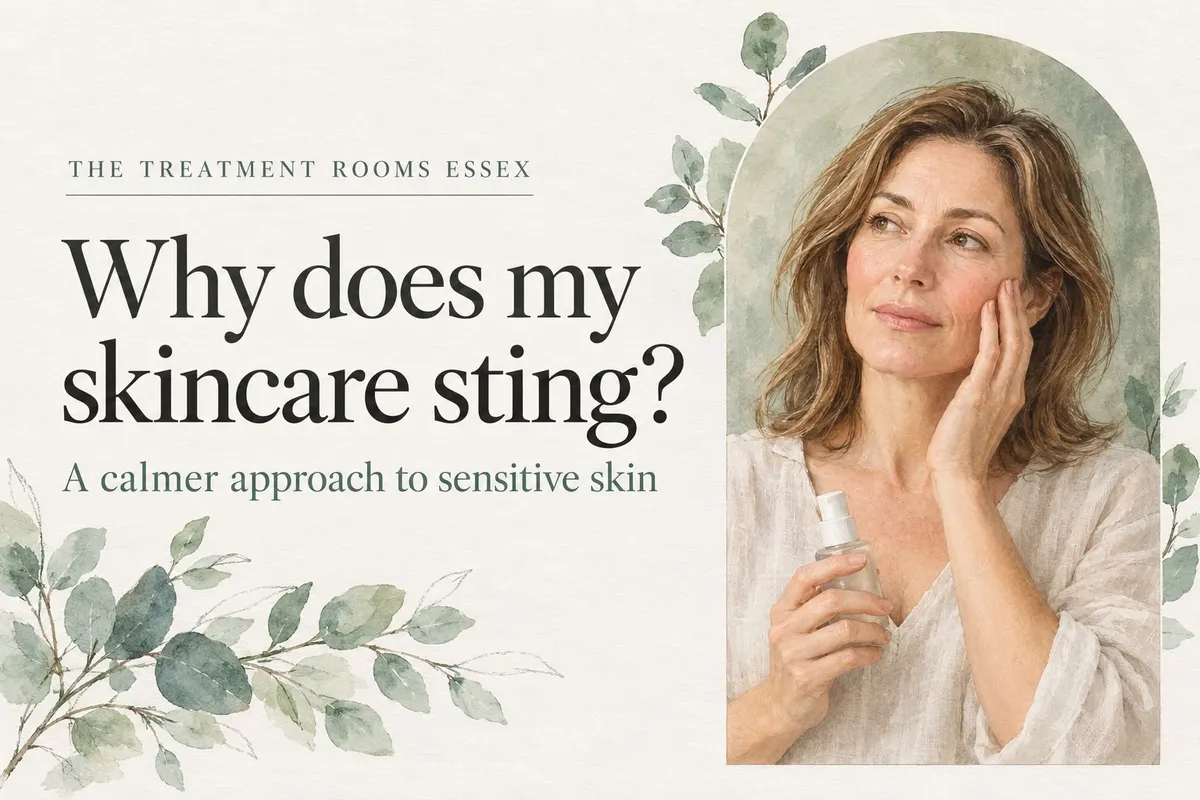
Why does my usual skincare suddenly sting
The moisturiser you have used for years suddenly stings. Your favourite serum makes your cheeks uncomfortable, and even washing your face has become something you approach cautiously. You are checking every label and wondering whether your skin has decided to reject the entire bathroom cabinet.
When you say, “I do not recognise my skin,” I take that seriously. You want to feel comfortable using everyday products again. You also want someone to explain what might be happening without immediately handing you six replacements. That is a reasonable place to begin.
A familiar product can still cause a problem
Skin irritation can have several causes. Contact dermatitis may develop when something irritates your skin or triggers an allergic reaction. Cosmetics and their ingredients can be involved, and a reaction may be immediate or delayed. Being familiar with a product does not automatically rule it out. [11, 12]
However, stinging alone cannot tell us the cause. It does not prove an allergy, a damaged barrier or a hormonal change. I would rather ask careful questions than attach a fashionable label to uncomfortable skin. You need advice that follows what is happening to you.
Could hormones be part of the picture
Dryness can accompany perimenopause and menopause, and skin may also become more easily irritated. That makes hormonal changes worth discussing if they fit your wider experience. It does not mean that every reaction should be explained away as menopause. [1, 2]
Think about when the problem began. Have you added an exfoliant, changed your washing habits or started a medicine? Has the product itself changed? Does the irritation happen around your eyes, across your cheeks or wherever you apply one particular cream? Those details can help guide the next step.
Stinging is not a target to work towards
A product does not earn extra points because you can feel it working. Persistent burning, soreness or a rash is a reason to stop and seek advice, rather than a challenge to push through. I would not recommend repeatedly applying something that is causing a reaction to prove you can tolerate it.
If it is a prescribed product, contact your pharmacist or prescriber about the reaction and how to proceed. Keep the packaging and note what happened. A clear account is more useful than trying to remember later which of several similar tubes you used that evening.
Make space to understand your routine
When every product feels suspicious, starting several new ones at once can leave you with even more uncertainty. My first question is usually about the whole routine. What are you using each morning and evening, and what happens to your skin afterwards?
Include cleansing tools, masks and occasional treatments. Mention products applied near your face, such as haircare, too. You do not have to identify the culprit before asking for help. Working out what information matters is part of the conversation. A consultation should make the situation feel clearer, rather than become another test you need to pass.
Simple should still mean personal
Dermatology advice for reactive skin often focuses on gentle care, moisturising and avoiding identified irritants. Fragrance-free products may be helpful. But a label such as sensitive does not promise that every person will tolerate a formula. Individual reactions and any underlying condition still matter. [13, 14]
That is why I would ask about textures, comfort and previous experiences before suggesting homecare. Perhaps you hate thick creams. Perhaps you have tried three gentle cleansers and none felt right. Tell me. There is no benefit in recommending a routine you already know you cannot comfortably use.
Your budget matters as well. If you are thinking, “I have spent a fortune trying to fix this,” I want that information early. We can discuss priorities and the purpose of any recommendation. You should understand what you are being offered and have time to decide.
What I can offer at The Treatment Rooms
My role is to listen, review the skincare and cosmetic treatment options within my scope, and explain when a medical opinion is needed. I can help make your next step more understandable. I cannot diagnose a cosmetic allergy from a consultation or promise to identify every trigger.
Bring your products or clear photographs of the labels to the clinic in Braintree. If you have photographs showing the reaction at its worst, those may help the discussion too. Tell me if you are nervous about touching your skin or having a treatment. We can talk before deciding whether any procedure is appropriate.
Sometimes the useful outcome is a homecare discussion. Sometimes it is postponing a treatment and recommending medical assessment. I would rather explain why we are waiting than carry out a facial because you felt you ought to have something done. Your comfort belongs in every decision.
When a rash needs more than a skincare review
Contact your GP if symptoms are persistent, recurring or severe, or if you cannot identify the cause. A clinician can assess whether dermatitis or another condition is involved and whether further testing is appropriate. A home product test is not a substitute for specialist allergy testing. [11, 15]
If a reaction causes sudden swelling of your lips, tongue or throat, or breathing difficulty, call 999 for emergency help. These are emergencies. [22] For ongoing mild irritation, keep a note of products and symptoms so you have useful information when speaking with a professional.
You can ask for a calmer starting point
You do not need to arrive with an ingredient dictionary or apologise for being cautious. “I just want washing my face to feel straightforward again” is a useful goal. So is wanting to feel heard after several disappointing attempts to find help.
Book a consultation
Book a consultation at The Treatment Rooms in Braintree. Bring your questions and the routine that has become confusing, and I will help you consider a clear next step. No judgement about the cupboard full of products. We have enough to discuss without giving your bathroom shelf a personality assessment.
Sources
Sources for this article. Numbers match the references in the text.
1. NHS. Symptoms of menopause and perimenopause
2. American Academy of Dermatology. Caring for your skin in menopause
11. NHS. Contact dermatitis
12. NHS. Contact dermatitis symptoms
13. NHS. Contact dermatitis treatment
14. American Academy of Dermatology. Rosacea skin care tips
15. NHS. Contact dermatitis diagnosis
22. NHS. Allergies and emergency symptoms