
Map My Mole FAQs: Mole Checks in Braintree Explained
Let's talk about that mole. You know the one. The one you check in the bathroom mirror, decide is probably fine, then check again three days later. Or the one on your back you can only see with two mirrors and some impressive contortion.
You're not being dramatic. Wanting to know what's going on with your own skin is just sensible. I offer Map My Mole checks here at The Treatment Rooms in Braintree, and I get asked the same questions every week, so here they all are in one place. Grab a cuppa. Let's sort it.
What is Map My Mole?
Map My Mole is an independent mole review service. I take detailed close-up images of your moles or blemishes here at the clinic, and a UK consultant dermatologist reviews them remotely and sends you a written report.
In plain English: a specialist opinion, without the long wait, and something clear in writing to hold on to.
Is Map My Mole part of The Treatment Rooms?
No, and I always want to be completely straight with you about this. Map My Mole is a third-party service provided by a community of UK consultant dermatologists. It isn't run by me or by The Treatment Rooms.
I'm a trained Map My Mole provider. My job is to look after you on the day and capture clear, detailed images. The dermatologist's job is to review them and give their opinion. Two sets of expert eyes, each doing what they do best.
Who reviews my mole images?
A UK consultant dermatologist from the Map My Mole community. They look at the detail in your images alongside the history you've shared with me, then write your report independently.
What happens at the appointment?
I know the unknown is often the hardest part, so here's exactly what to expect. No surprises, no overwhelm.
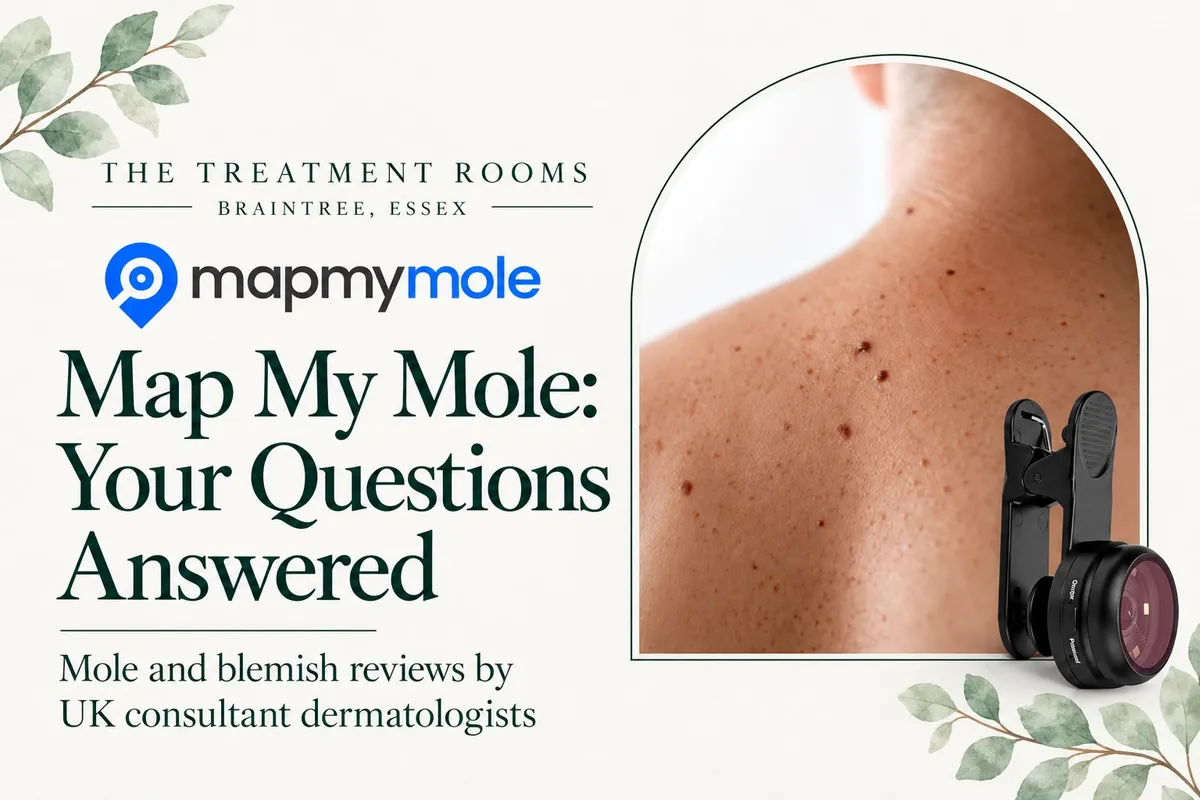
We start with a chat about your skin, your history and any changes you've noticed. Then we agree which moles or blemishes you'd like checked. I photograph each one with a medical-grade dermatoscope, a small magnifying lens that rests gently on your skin and picks up detail you can't see with the naked eye. Your images are then uploaded securely to Map My Mole.
If you're nervous, tell me. I'll explain every step before I do it, and we'll go at whatever pace suits you. No judgement, ever. You're in safe hands.
Does a mole check hurt?
Not even slightly. The lens just rests on your skin. No needles, nothing sharp, and nothing is removed. Honestly, the hardest part is remembering where all your moles are.
How long does the report take?
Reports often arrive in as little as 24 hours after your images are taken. Times can vary, and if there's ever a delay, I'll let you know.
Your report comes by email in plain English, so no decoding medical jargon at midnight. You and the clinic both get a copy as standard, but if you'd rather keep it private, it can come to you only.
Can Map My Mole diagnose cancer?
No. Map My Mole can't diagnose cancer, and neither can I. I'd rather tell you that straight than let you assume otherwise.
Your report gives a UK consultant dermatologist's professional opinion on what a mole or blemish is likely to be. If it needs further investigation and histology, where a small sample of skin is examined in a lab, your report will tell you. You can then give the report to your GP, who can arrange the next steps.
For lots of people, the report simply brings peace of mind. And if something does need a closer look, the Map My Mole team will also call you to check you've read your report and know what to do next. You won't be left to figure it out alone.
Can I take my report to my GP?
Yes. If you need a referral, let your GP know your mole has been assessed and that you have a report from a UK consultant dermatologist. It gives them clear, specialist information to work from.
One important thing: if a mole is changing quickly, or bleeding without being knocked, please contact your GP straight away rather than waiting for an appointment with me.
Can you remove my mole?
Map My Mole is an advice service only, so it doesn't remove moles or advise on removal.
I do treat lots of skin blemishes at the clinic, from skin tags to cherry angiomas. Skin tags: harmless? Yes. Annoying? Absolutely. But I made myself a promise early on that I would never treat a mark that hadn't been properly checked. So if you'd like something removed, it gets checked first. Then we can talk through whether it's suitable for treatment.
When should I get a mole checked?
You don't need a reason beyond wanting peace of mind. That said, these are all good reasons to book:
A new mole or mark that has appeared in adulthood
A mole that has changed in size, shape or colour
One that looks different from your other moles
A mole that itches, crusts or bleeds
Moles in hard-to-see places, like your back or scalp
A blemish you'd like removed, so we know exactly what it is first
And if you're in perimenopause or menopause and your skin has started sprouting things it never used to, yes, same. Skin tags and rough, raised patches called seborrhoeic keratoses often pop up from our forties onwards. They're usually harmless, but it's still reassuring to know exactly what you're looking at.
How much does a Map My Mole check cost?
Your first mole or blemish is £85. Each additional one checked at the same appointment is £25. Both prices include your images and a written report from a UK consultant dermatologist.
So if you've got a little collection on your mind, it makes sense to have them all looked at in one visit.
Ready to Put Your Mind at Rest?
I see clients from Braintree, Black Notley, Witham, Halstead, Coggeshall, Great Dunmow and across Essex, and everybody and every body is welcome here. If there's a mole you keep checking in the mirror, let's get it looked at properly so you can stop wondering. I've got you.
I'd love to help. Book your Map My Mole check online, or if you're not sure where to start, give me a ring on 07908 888466. I love a good skin chat.
Map My Mole is an independent third-party service. Mole and blemish reviews are carried out by UK consultant dermatologists within the Map My Mole community, not by The Treatment Rooms Essex. Reports give a professional opinion and are not a substitute for urgent medical care.