
PCOS and Facial Hair: What Is Actually Going On, and What You Can Do About It Permanently
BLOG POST | THE TREATMENT ROOMS ESSEX
PCOS and Facial Hair: What Is Actually Going On, and What You Can Do About It Permanently
Because you deserve more than another razor and a prayer
By Emma | The Treatment Rooms Essex, Braintree | Advanced Electrolysis and Skin Specialist
If you have PCOS and you are reading this, there is a very good chance that facial hair has been one of the most quietly exhausting parts of managing it. Not the headline symptom. Not the one that comes up first in the doctor's office. But the one that is there every single morning, and again by the afternoon, and again the next day.
Shaving. Plucking. Waxing. Threading. Bleaching. The constant cycle of managing something that just keeps coming back, sometimes faster, sometimes coarser, always inconvenient, often distressing.
I work with a lot of clients who have PCOS. It is one of the most common reasons people find their way to me. And I want to use this post to explain honestly what is happening hormonally, why so many standard hair removal routes fall short, what electrolysis actually does differently, and how I look at PCOS hair removal as part of a wider picture of skin and hormonal health.
Because the hair is only part of the story.
What PCOS is actually doing to your hair follicles
Polycystic Ovary Syndrome is a hormonal condition that affects roughly one in ten people with ovaries. One of its most visible effects is hirsutism, which is the medical term for excess hair growth in areas typically associated with male-pattern distribution: the chin, upper lip, jaw, neck, chest, stomach and inner thighs.
The driver is androgen dominance. PCOS causes elevated levels of androgens, particularly testosterone, which stimulate hair follicles to produce thicker, darker, more persistent hair in these areas. The follicles respond to the hormonal signal by activating and producing hair that would not otherwise be there, or by converting fine, barely-visible hair into coarse, dark strands that are impossible to ignore.
And because the hormonal signal is ongoing, the hair keeps coming. Laser can slow it down. Waxing manages it temporarily. But as long as the androgen levels remain elevated, new follicles can activate, and previously treated ones can be restimulated.
This is why so many people with PCOS feel like they are fighting a losing battle. It is not a failure of effort or commitment. It is the nature of a hormonally-driven condition, and it requires a different approach.
“I lacked confidence and was always self conscious about going out. I was worried that people would make comments about the facial hair.”
Ciara | PCOS client
“Shaving everyday became usual but I know that is not normal. Some days I don't want to shave or wear makeup so having to think about that was tiring and bothersome.”
Harinie | PCOS client
The mental load that Harinie describes, the daily calculation of shaving, covering up, checking, worrying, is something I hear about constantly. It is real and it is exhausting, and it is one of the reasons I feel strongly that PCOS hair removal deserves a proper long-term solution, not just another short-term fix.
Why laser often falls short for PCOS hair growth
Laser hair removal can absolutely help with PCOS. I offer laser at The Treatment Rooms and for the right hair type and skin tone, it delivers excellent reduction. But there are two important limitations that are worth understanding before you commit your time and money.
Limitation one: laser targets pigment
Laser works by targeting melanin in the hair shaft. This means it is most effective on dark, coarse hair against lighter skin. As PCOS hair changes over time, becoming lighter or finer in some areas, or if your natural colouring means the contrast is not strong enough, laser becomes less effective. White, grey, or fine unpigmented hairs simply cannot be treated by laser at all.
Limitation two: hormones can override the result
Laser can successfully treat a follicle, but if your androgen levels remain elevated, a dormant neighbouring follicle can activate and produce a new hair in the same area. This is not laser failing. It is a new follicle responding to the same hormonal signal. The result is that maintenance sessions are often needed indefinitely, rather than a course of treatment with a genuine end point.
There is also a phenomenon called paradoxical hypertrichosis, where laser stimulates finer hair in the treatment area to grow thicker and darker. Research suggests this occurs more frequently in clients with hormonal imbalances including PCOS, particularly on the face and neck. It is not common, but it is something I always discuss honestly with clients before recommending laser for hormonal facial hair.
“I worried about the cost after spending money on laser and it not giving me the full results I wanted.”
Rhiannon | PCOS client
Rhiannon's experience is one I hear often. Money spent, some results, but not the permanent resolution that was hoped for. It is part of why I think honest conversation about the right tool for each client matters so much more than just selling sessions.
→ Read more about electrolysis versus laser hair removal [link to /electrolysis-permanent-hair-removal]
Why electrolysis is different for PCOS clients
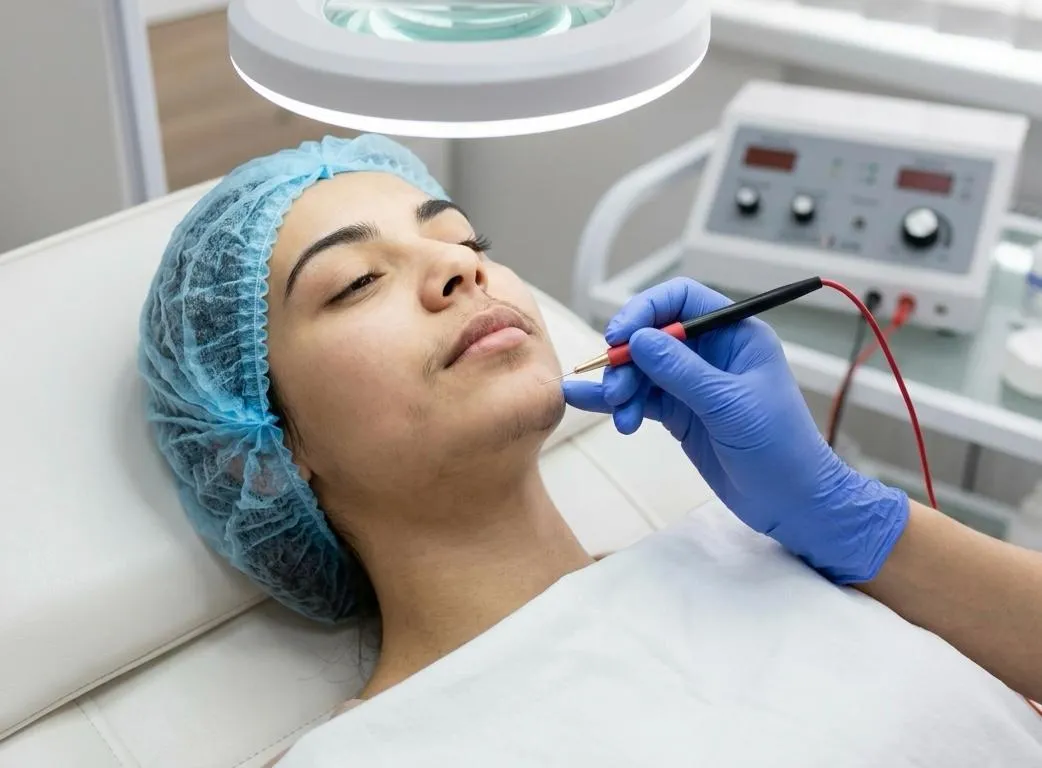
Electrolysis permanently destroys each individual hair follicle using a direct electrical current delivered through a fine sterile probe. The follicle is destroyed. It cannot be reactivated by hormonal signals because it no longer exists.
This is the key distinction. A treated follicle cannot grow hair again, regardless of what your hormones are doing. New follicles can still activate in nearby areas if androgen levels remain high, which is why a course of treatment over time is needed rather than a single session. But every follicle that is successfully treated is permanently gone. You are making real, irreversible progress with each session.
Over a course of treatment, the density of hair reduces consistently and noticeably. The total volume of hair to manage decreases. Many of my PCOS clients reach a point where the remaining hair is so fine and sparse that it is no longer a daily concern. That endpoint is real, and it is achievable.
“Electrolysis is the best decision I made for permanently removing facial hair. It takes time but the end results are so worth it. You will feel so much more confident even after the first session.”
Ciara | PCOS client
“I can go a few days not shaving or using makeup, and I can feel my face with less stubbly bits. I feel less anxious and more comfortable just in my day-to-day life walking around bare faced. Do it. If it is impacting your daily life as it did mine, do it.”
Harinie | PCOS client
PCOS, skin breakouts and the bigger picture
Hair is usually what brings PCOS clients to me first. But once we start talking, the skin conversation almost always follows. Elevated androgens do not only stimulate hair follicles. They also increase sebum production, which contributes to congestion, breakouts, and the kind of persistent hormonal acne along the chin and jaw that just does not respond to standard skincare.
Sound familiar?
The chin and jaw area is significant here because it is both a common site for PCOS facial hair and a classic hormonal breakout zone. The two things are driven by the same underlying cause, which means that addressing one in isolation, without thinking about the skin it sits in, is only doing half the job.
This is where Allskin Med comes in. I stock and use Allskin Med both as a professional in-clinic treatment and as a retail skincare range that I recommend to clients managing hormonal skin. It is a medically-led skincare line specifically formulated to address the kind of reactive, congested, androgen-driven skin that PCOS clients so often deal with. Where other skincare ranges are too gentle to make a real difference, or too aggressive and strip the barrier, Allskin Med is built to work with compromised and hormonally-affected skin.
When I am assessing a client with PCOS, I am not just looking at the hair. I am looking at the skin it is growing from. The texture, the congestion, the healing response. Because treating the hair on skin that is already inflamed or compromised requires a different approach, and because what you put on your skin at home matters enormously to how well it responds to treatment and how clearly it heals.
If your skin is breaking out alongside the hair growth, that is not two separate problems. That is one hormonal picture, and it deserves a joined-up response.
→ Find out more about Allskin Med skincare at The Treatment Rooms [link to /allskin-med]
What you eat matters more than most people realise
I am an electrologist and a skin specialist, not a nutritionist. But I have spent enough time working with PCOS clients to know that what is happening inside the body shows up on the outside, and that the conversation about hormonal hair and skin health is incomplete without acknowledging the role that food and lifestyle play.
Androgens are affected by insulin levels. Insulin resistance is common in PCOS and contributes directly to elevated androgen production. What you eat, how you manage blood sugar, and how you support your body's hormonal balance day to day genuinely influences how active your hair follicles are and how your skin behaves.
This is something I care enough about that I have written my own recipe book, Hormone Harmony, specifically with hormonal health in mind. It is not a diet plan. It is a practical, real-life resource full of recipes designed to support balanced blood sugar and reduce the kind of hormonal spikes that make PCOS symptoms worse. The kind of food that works with your body, not against it.
Electrolysis does the work on the follicles. Allskin Med supports the skin. Hormone Harmony supports the whole hormonal picture. None of these things replaces the others, but together they represent the most complete approach I know to managing PCOS from the outside in and the inside out.
Hormone Harmony: Emma's recipe book for hormonal health
A practical recipe book written by Emma at The Treatment Rooms, designed to support blood sugar balance and hormonal health for clients managing PCOS, perimenopause, menopause and other hormonally-driven conditions.
→ Find out more about Hormone Harmony [link to /hormone-harmony]
Body hair and PCOS: it is not just the face
Facial hair tends to be what clients find most distressing, which is why it comes up first. But PCOS-related hair growth does not stop at the chin.
Hirsutism commonly affects the stomach, chest, upper arms, inner thighs, and lower back. For many clients, body hair in these areas is just as significant to their confidence and comfort as facial hair, and it deserves the same considered, permanent approach.
Electrolysis can treat body hair as well as facial hair, and for hormonally-driven growth in areas where laser may not be effective (due to hair colour, skin tone, or previous treatment history), it is often the more reliable long-term option.
Body hair sessions are typically longer than facial sessions, and the treatment plan looks different because body hair tends to be coarser and the areas larger. I will always talk through a realistic plan with you based on the specific areas you want to address, your timeline, and your priorities.
If body hair has been affecting your confidence as much as facial hair, please bring it up at your discovery call. You do not have to choose between the two. We can work on both, in the right order and at a pace that works for you.
“My body hair made me feel like I wasn't a real woman. Even though body hair is completely normal there was always something in the back of my mind telling me otherwise. I avoided certain clothes if I hadn't shaved in case someone might see. This treatment has given me my confidence back. Body hair has been a massive insecurity for me since I was a teen. This procedure has liberated me in more ways than I could have ever imagined.”
Maddy | Client, body hair treatment
Maddy's words speak for themselves. Body hair is not a trivial concern, and it is not something you simply have to live with. It is treatable, permanently, and the impact on confidence and daily life can be profound.
What your PCOS hair removal journey looks like at The Treatment Rooms
It starts with a free 15-minute discovery call. I want to understand your full picture: where the hair is, how long you have been managing it, whether you have had any previous treatments, what your skin is like, and what a successful outcome looks like for you.
From there we arrange a patch test and consultation. I assess your skin and hair carefully, because PCOS skin can be sensitive and reactive, and I always want to understand how your skin heals before we begin a full course of treatment. This is not a formality. It is information I genuinely use to build your treatment plan.
I will be honest with you about timescales. PCOS hair removal takes longer than non-hormonal hair removal. New follicles can activate throughout treatment. Progress is real and visible, but it is not a straight line, and anyone who tells you otherwise is not being straight with you. What I can tell you is that every treated follicle is gone for good, and the cumulative effect of consistent treatment is significant.
I use Sterex equipment and Elite Probes throughout, and I focus on skin preservation at every session. For clients with hormonally-compromised skin, I will often recommend specific Allskin Med products to support healing between appointments and keep the skin in the best possible condition throughout the course of treatment.
“I felt reassured and hopeful that there was a permanent solution. After having a telephone consultation and patch test before treatment I knew it was the right place. I felt really reassured about starting the treatment and throughout all my appointments.”
Ciara | PCOS client
You do not have to just manage this forever
PCOS is a lifelong condition. The hair does not have to be.
Electrolysis will not change your hormones. It will not stop PCOS from existing. But it will permanently remove the follicles that are producing hair right now, reduce the overall volume and density of growth over time, and give you a genuine end point rather than an indefinite management routine.
Paired with the right skincare support and some attention to what is going on internally, the picture changes considerably. I have seen it happen for client after client, and I want the same for you.
The discovery call is free. It is 15 minutes. And it is the first step toward not having to think about this every single morning.